What Always Has Been Done Will Continue to Be Done
Imagine you finished a task, and need to share it with someone. How would you express yourself? Would you say "It's Done" or "It Has Been Done"?
We're sure both expressions are correct, but how and when should we use them? Let's take a closer look and find out.
It's Done or It Has Been Done – Which Is Correct?
"It's Done" and "It Has Been Done" are grammatically correct and are acceptable forms to express that a task or activity has been completed. However, "It Has Been Done" is a passive form, and shouldn't be used if you're the person who just finished the job.
Let's look at some examples, and try to make sense of the differences. Imagine someone asks the following question: "Have you completed the project?". There are two ways someone could respond:
- Yes, it's done.
- Yes, it's been done.
The examples show that both answers work for the question about the project being finished. However, it's undeniable that it sounds off to say "It Has Been Done" when the subject is the one who did it.
It's one of those situations where the sentence is grammatically correct but doesn't sound organic. You should keep that in mind when choosing between "It's Done" and "It Has Been Done".
It's Done
"It's Done" is the most emphatic way to state that a task or activity is completed, at the time of the question. It's direct and straight to the point – which is often what's expected in a professional environment.
Let's take a look at some examples, that will show "It's Done" in use:
- Clovis asked if the report has been finished, and I told him it was done.
- Did Anna finish her homework? Yes, it's done.
- Did you do what I asked yesterday? No, it's not done, but I'll finish it soon.
- Is the cake ready? Yes, it's done.
- "It's done", is what they said on the phone, but when I got there, the cake wasn't ready.
"It's Done" is an assertive way to state that an activity has been completed. It has variations, such as "It Was Done", in the past, or "It's Not Done", as a negative. But it's always a straight-to-the-point form.
It Has Been Done
"It Has Been Done" conveys the same basic message as "It's Done", however through a passive voice. It works best when the subject isn't involved firsthand.
Take a look at the examples below:
- Has anyone finished the report? No, it hasn't been done yet.
- Did the seamstress ever finish sewing that shirt? Yes, it's been done.
- Has Leo finished all the letters? Oh yes, they've been done.
- I told my boss it was a bold goal, but it has been done before.
- Rebuilding a business after a disaster isn't fun, but it's been done before.
"It Has Been Done" indicates that a task or activity has been performed in the past, without asserting the exact time. It also doesn't necessarily indicate who performed the task.
This expression, constructed as "It'd Been Done" often serves as a reference, but isn't meant to pinpoint an individual or a particular instance. It works better, as a passive voice, in those cases.
Which Is Used the Most?
Which one of those two forms are used more often, "It's Done" or "It Has Been Done"? Take a look at the graph from Google Ngram Viewer below.
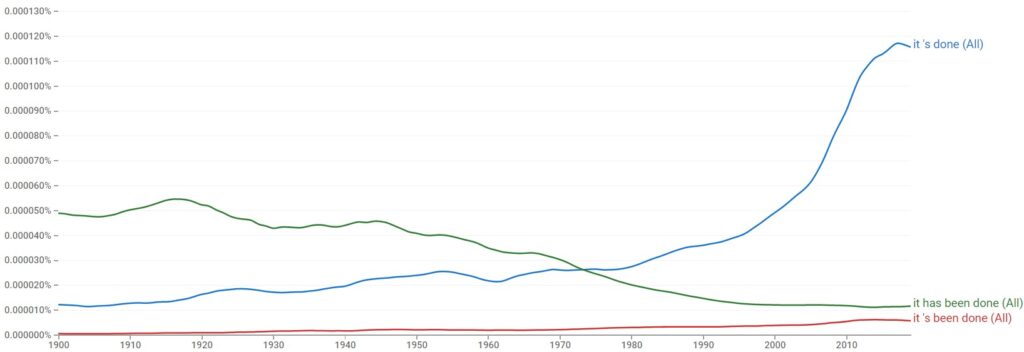
"It's Done" is the predominant one, appearing much more often than "It Has Been Done". Even if we sum up "It Has Been Done" and "It's Been Done" (the contracted form), "It's Done" remains much more prevalent.
We think it's the case because "It's Done" is direct and straightforward, and that's how most people prefer to communicate. The passive voice isn't always the best fit.
Work Is Done or Work Has Been Done?
The "Work is Done" form is the most direct to reflect that a task has been finished or completed. To say that "Work Has Been Done" isn't incorrect, just harder to apply – but it could work as a reference or a general information sentence.
Take a look at some examples, that show "Work is Done" as more specific and "Work Has Been Done" as a more general statement:
- The tile work in the bathroom is done.
- Some work has been done to the bathroom.
Source: https://grammarhow.com/its-done-or-it-has-been-done/
0 Response to "What Always Has Been Done Will Continue to Be Done"
Publicar un comentario